DeepSeek V4.1 Flash vs GLM 5.3 Flash: Price and Speed Test
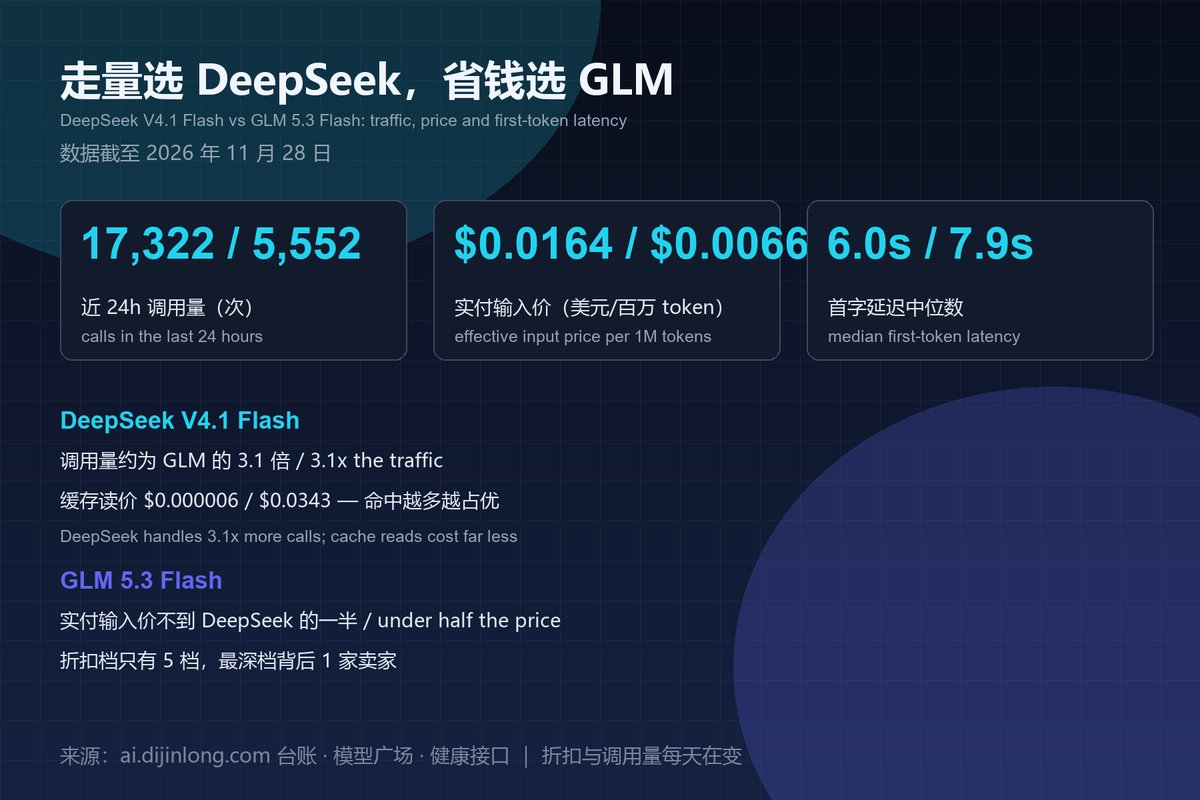
Pick deepseek-v4.1-flash for high-volume work; pick glm-5.3-flash when price or long context matters more. DeepSeek handled about 17,322 calls in the last 24 hours, roughly 3.1 times GLM's 5,552. Its median first token arrived in about 6.0 seconds, around 24% quicker than GLM's 7.9. GLM, however, charges just $0.0066 per million input tokens after seller discounts, less than half DeepSeek's $0.0164. Data as of November 28, 2026.
These are the two busiest text models on the platform right now, so the comparison is worth grounding in numbers rather than impressions. Every figure below comes from a same-day snapshot: list prices from the pricing ledger, discounts from the marketplace, traffic and latency from a single health response. Sources are kept separate rather than blended.
List price: a 2.5x gap that discounts do not close
deepseek-v4.1-flash lists at $0.2987 input and $1.1949 output per million tokens. glm-5.3-flash lists at $0.1195 and $0.4182. That makes DeepSeek 2.5 times dearer on input and 2.9 times dearer on output.
What buyers actually pay is list price multiplied by (1 minus the buyer discount). Both models currently top out at 94.5% off, leaving 5.5% of list. The gap therefore survives: DeepSeek settles at $0.0164/$0.0657, GLM at $0.0066/$0.0230. At 100 million input tokens, the DeepSeek bill is about 2.5 times the GLM bill.
Discounts are not permanent. They move with the sellers who list each model. Check the live model marketplace before committing a budget.
Measured behaviour: speed separates them
The health snapshot shows deepseek-v4.1-flash at about 17,322 calls, 99.95% success, roughly 6.0 seconds to first token and about 80.6 tokens per second. glm-5.3-flash shows 5,552 calls, 99.98% success, 7.9 seconds and about 22.99 tokens per second.
The useful difference is generation speed: DeepSeek runs at about 80.6 tokens per second against GLM's 22.99, a 3.5 fold gap. First-token latency is closer than it looks, with both models in the six-to-eight-second range. Neither is a good fit for snappy chat UI; both suit batch jobs and streaming workflows that can absorb the wait.
Success rates sit near 100% for both, differing by 0.03 percentage points. That is too small to drive a decision. Traffic volume tells you what others picked, not what will work for your workload.
Cache hits flip the ranking
Repeated system prompts and reference material make cache-read pricing more important than input pricing. Here the result reverses: deepseek-v4.1-flash reads cached tokens at $0.005975 per million, while glm-5.3-flash charges $0.0343, roughly 5.7 times more.
GLM has the lower headline input price but gives up less on cache hits. DeepSeek prices cache reads at just 2.0% of its input rate. Long prompts and multi-turn conversations with shared context can end up cheaper on DeepSeek than the input price alone suggests.
Neither model has a listed cache-write price, so do not budget a separate write fee. Check the usage breakdown returned by each request for the authoritative charge.
Discount depth is not the same for both
deepseek-v4.1-flash currently has 10 buyer discount tiers, running from 94.5% down to 50%. glm-5.3-flash has 5, from 94.5% to 50%.
More tiers mean more room to find a cheap route, but each tier can sit on a different upstream. The deepest DeepSeek tier spans 3 sellers; GLM's deepest tier has 1. A price edge backed by a single seller is a different risk profile from one backed by several.
Three workloads, three answers
High-volume batch jobs: deepseek-v4.1-flash. Faster generation shortens queues and low cache-read pricing rewards repeated context.
Cost-sensitive classification and extraction: glm-5.3-flash. Cheap input tokens matter more than output speed when responses are short.
Long context or a single predictable route: compare the live tiers in the price table first. The GLM family includes 1M-context variants, but do not assume this flash model inherits the same specification.
Two traps worth avoiding
First, a flash model is not simply a discounted flagship. Pricing, cache behaviour and speed curves are independent. Run a small real-traffic test before shifting production load.
Second, volume is not a quality ranking. Call counts reflect defaults, promotion and a rolling window. Verify latency and stability with your own prompts. All figures are as of November 28, 2026 and will move with the market.
Related Articles
Cut Your AI API Bill: How Seller Tiers Really Work
One model can carry ten seller quotes. Here is how buyer discounts work, how to read the tiers, and where the cheapest route stops being the smart one
Zhipu GLM Models: All 11 Versions Priced (2026)
Zhipu sells 11 GLM models, and the newest flagship can cost 56% less than older ones once seller discounts apply. Full price table.
Do Failed AI API Calls Cost You Money?
Failed AI API calls are never billed. Errors post a zero-cost row, and 57 of 103 models have backup sellers for automatic retry.
Long-Context Pricing: Why 272K Tokens Cost Double
Past 272K tokens input pricing doubles on most 1M-context models, and qwen3.6-plus jumps 4x at 256K. Real tiers plus four ways around them.
What $10 Actually Buys on an AI API Marketplace
$10 buys 4.55M to 667M input tokens here, a 147x spread. Real discount math, per-request costs, three budget builds, and the traps behind cheap models