Do Failed AI API Calls Cost You Money?
The short answer: a failed call costs nothing
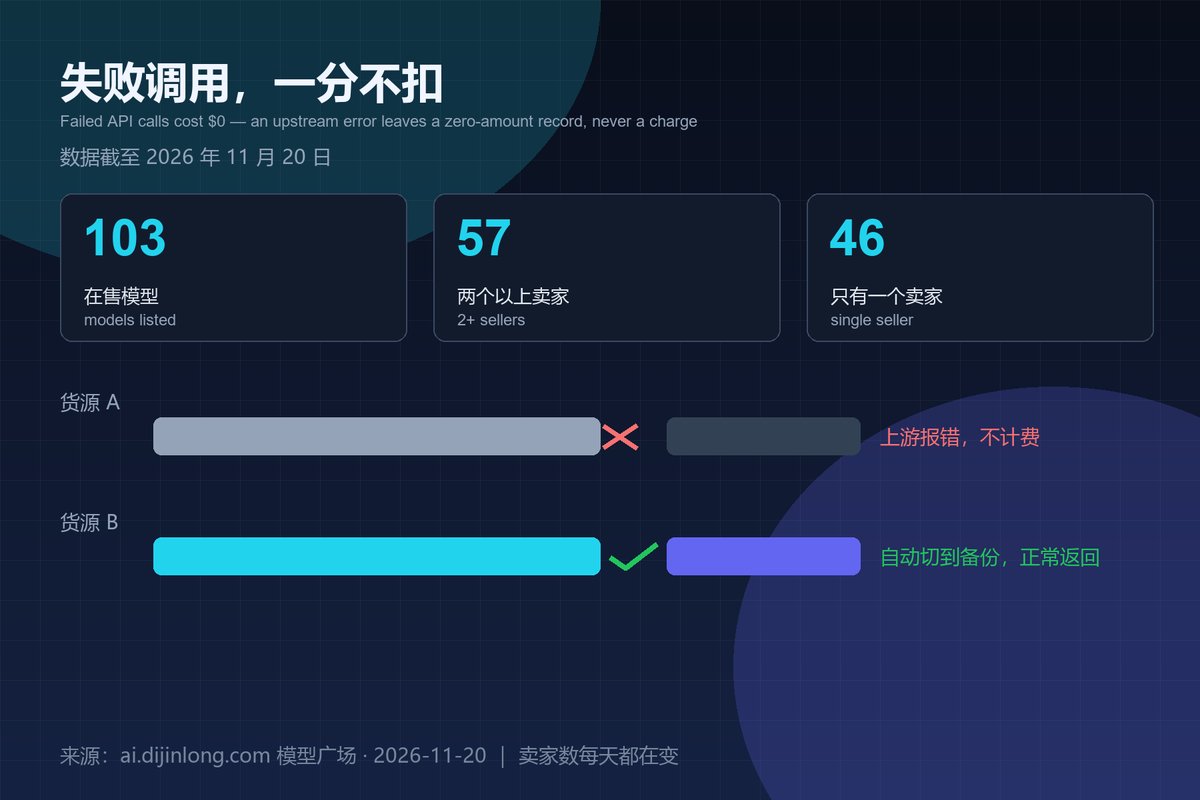
No, a failed AI API call does not cost you money. The platform's billing rule is explicit: failed requests are not billed. When an upstream provider returns an error, a connection times out, or the model refuses to answer, your balance stays untouched. All that is left behind is a usage row with a zero amount. Data as of Nov 20, 2026.
Most of the time you never notice a failure at all. Whenever a model has more than one seller, the gateway detects a failing source and quietly retries against another one. You get a single successful response, with no config change and no resend on your side.
How a failure is identified: by amount, not by status code
There is no separate success flag. The amount is the signal. A call that actually consumed tokens produces a charge above zero; a call that died before producing anything lands as a placeholder row with zero tokens and zero cost.
In your usage table, those zero-amount rows are the attempts that did not succeed, and they never enter your spend total. The rows are kept on purpose: they prove the request reached the platform and was forwarded upstream, rather than being dropped. Each billable unit is also keyed to a request fingerprint, so a duplicate report cannot charge you twice.
How much backup capacity exists: 57 of 103 models
Automatic failover only works when a model has a second seller. On the Model Plaza listing of Nov 20, 57 of 103 models had two or more sellers, while 46 had exactly one.
| Seller count | Models | Notes |
|---|---|---|
| Two or more sellers (auto failover) | 57 | gpt-6-astra 13, gpt-5.6-sol 12 |
| Single seller (no fallback) | 46 | 35 of them are text models |
| Models listed | 103 | Model Plaza, Nov 20 |
The more sellers a model has, the more resilient it is. gpt-6-astra runs on 13 sellers and gpt-5.6-sol on 12, so a single bad source is close to invisible. A model with one seller has nowhere to go when that source breaks, which is why seller count is worth a glance when you pick a model.
When you do pay
Three cases are billed: a normal response, even one truncated by max_tokens, charged on actual tokens; cache hits, charged at the cache read rate, which sits below the input rate; and per-call or per-second media tasks such as image and video generation, charged once they return successfully.
In other words, the only thing that triggers a charge is usage actually being consumed, not whether you saw a complete answer. Saving money is a question of controlling input length and cache hit rate, not of worrying about failed calls.
How to check it yourself
Your console's usage table filters by date and exports to a file, with model name, token count and amount on every row. Reconcile by summing the amount column and comparing it against the change in your balance; if the two match, nothing was overcharged, and zero-amount rows are excluded.
Three practical habits: pick models with three or more sellers so failover can actually happen; for single-seller models, add retries and keep a same-price fallback ready; export a usage table once a month instead of reconstructing it after a dispute. Live rates are on the pricing page.
Related Articles
Zhipu GLM Models: All 11 Versions Priced (2026)
Zhipu sells 11 GLM models, and the newest flagship can cost 56% less than older ones once seller discounts apply. Full price table.
Long-Context Pricing: Why 272K Tokens Cost Double
Past 272K tokens input pricing doubles on most 1M-context models, and qwen3.6-plus jumps 4x at 256K. Real tiers plus four ways around them.
What $10 Actually Buys on an AI API Marketplace
$10 buys 4.55M to 667M input tokens here, a 147x spread. Real discount math, per-request costs, three budget builds, and the traps behind cheap models
GPT-6.2 Cuts Prices 20%: What the AI Price War Means
GPT-6.2 cuts list prices 20%, yet platform discounts run deeper: gpt-6-astra trades at under 1% of list. What this week's AI price war means for buyer
What Is Prompt Caching? How Cache Tokens Cut API Bills
Prompt caching stores a repeated prompt prefix and bills cache reads at 5-12% of normal input. Real prices, hit conditions, and how to cut your API bi