Cut Your AI API Bill: How Seller Tiers Really Work
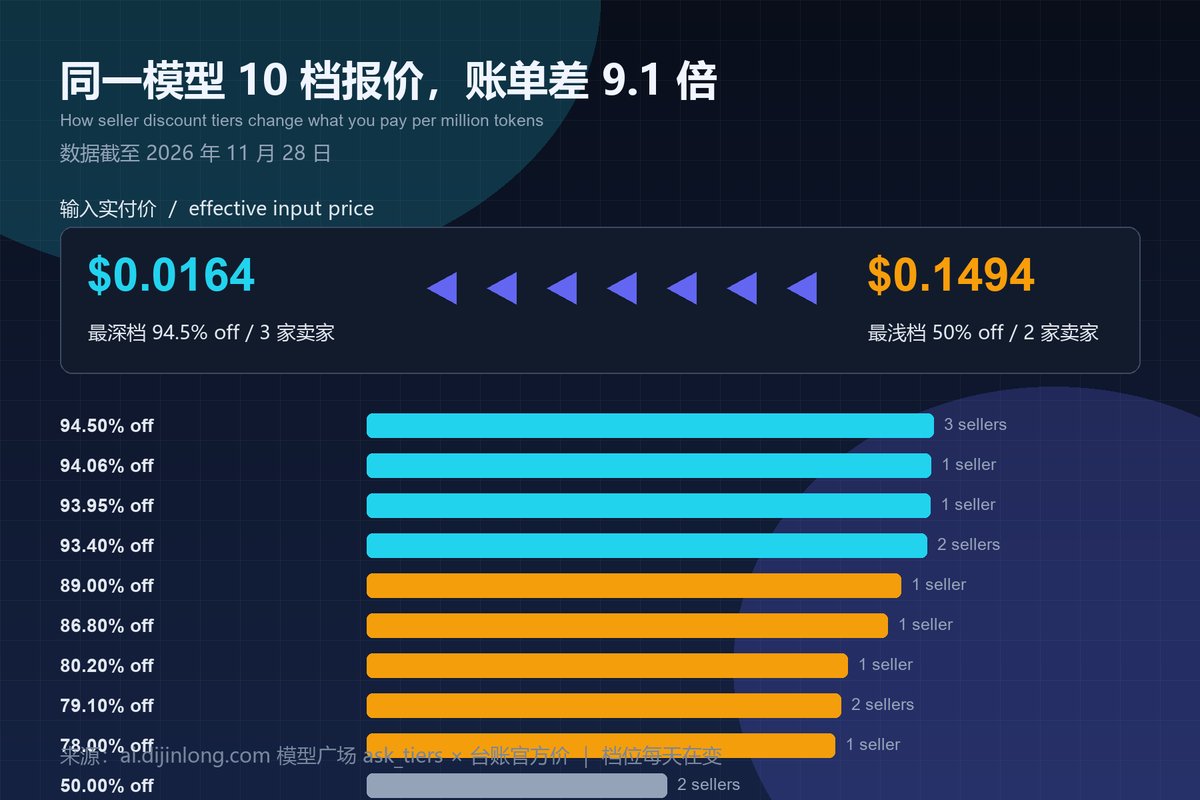
To cut AI API costs, check the seller tiers behind a model before switching models. deepseek-v4.1-flash currently has 10 quoted tiers, with buyer discounts from 50% to 94.5%. Effective input price ranges from $0.1494 to $0.0164 per million tokens, a 9.1 fold spread. For gpt-5.6-terra the spread reaches 0.0 fold. Asking "is this model expensive" misses the biggest lever. Data as of November 28, 2026.
This is a mechanism already live on the platform. No special access and no rewrite are needed: read the tiers, calculate the real price, and weigh latency alongside it. All numbers below come from one same-day snapshot.
Three prices, one bill
First, the list price in the ledger, denominated in US dollars per million tokens. deepseek-v4.1-flash lists at $0.2987 input and $1.1949 output.
Second, the seller quote. The marketplace is not run by the platform. Sellers list their own capacity and set their own discount. The ask_tiers array groups those quotes by discount depth and reports how many sellers sit behind each one.
Third, the effective price you actually pay: list price times (1 minus buyer discount). The ledger stores list prices only, so the effective price has to be calculated. The marketplace's official_pricing object also omits cache-write prices, so treat it as a partial view.
One multiplication, no extra division
The formula is effective price = list price x (1 - buyer_percent_off / 100). For deepseek-v4.1-flash input at the deepest 94.5% tier, $0.2987 x 0.055 gives $0.0164 per million tokens. At the shallowest 50% tier it is $0.1494.
Dividing those gives 9.1 fold, not a round ten. Do not tidy it into "10x" in a proposal: some list prices on the same platform differ by exactly tenfold, and mixing the two claims makes the whole document look careless.
Output and cache-read prices work the same way. Cache reads deserve their own calculation: deepseek-v4.1-flash lists cache reads at $0.005975 per million tokens, or $0.000329 at the deepest tier. For repeated prompts that number matters more than input price.
Read the current best tier in code
The marketplace endpoint is public and returns every model's tiers. Here is a minimal Python example using only the standard library:
import json, urllib.request
url = "https://ai.dijinlong.com/api/v1/model-plaza"
data = json.load(urllib.request.urlopen(url, timeout=20))
models = data["data"]["groups"][0]["models"]
name = "deepseek-v4.1-flash"
row = next(m for m in models if m["name"] == name)
best = max(row["ask_tiers"], key=lambda t: t["buyer_percent_off"])
print(best["buyer_percent_off"], best["sellers"])
The two values are the buyer discount and the number of sellers behind that tier. Multiply the ledger's list price by (1 minus discount / 100) to get the effective price. Buyers who do not need ledger access can simply read the effective price column in the price table.
Put that script on a daily schedule and log the best tier. You will spot the moment a model falls back from a deep discount to 50% off. Most savings come from catching that shift, not from discovering a new model.
The cheapest tier is not always the right one
A tier is a seller quote, and sellers may route to different upstreams. Check three things together: discount depth, seller count at that tier, and the model's recent success rate and latency.
The deepest deepseek-v4.1-flash tier at 94.5% spans 3 sellers; the next tier at 94.06% has 1. If the cheapest route runs slow, giving up 0.44 percentage points to reach more sellers is often better value.
The health endpoint reports deepseek-v4.1-flash at 99.95% success and about 6.0 seconds to first token, while gpt-5.6-terra shows 100% success and roughly 7.81 tokens per second. These are model-wide aggregates, not per-tier measurements. Good for scale, not for judging one specific quote.
Three mistakes to avoid
Treating tiers like coupons. They are live seller quotes. When a seller delists or reprices, the tier disappears. Budget with a fallback to 50% off rather than signing a delivery price at the historical low.
Ignoring cache-read prices. A model with cheap input tokens can charge more for cache hits. glm-5.3-flash lists input at $0.1195, below deepseek-v4.1-flash at $0.2987, but cache reads at $0.0343, above DeepSeek's $0.005975. The more context you reuse, the more this flips the bill.
Mixing data sources. Ledger, marketplace and health endpoint use different scopes and refresh times. Take prices from the ledger, discounts from the marketplace, and the whole traffic-and-latency group from one health response. Dividing numbers from different sources produces a figure that looks precise and means nothing.
Figures are as of November 28, 2026. Re-run the endpoint before applying any of this to production.
Related Articles
DeepSeek V4.1 Flash vs GLM 5.3 Flash: Price and Speed Test
DeepSeek V4.1 Flash carries three times the traffic of GLM 5.3 Flash. Real prices, latency and cache rates show which one fits high-volume calls.
Zhipu GLM Models: All 11 Versions Priced (2026)
Zhipu sells 11 GLM models, and the newest flagship can cost 56% less than older ones once seller discounts apply. Full price table.
Do Failed AI API Calls Cost You Money?
Failed AI API calls are never billed. Errors post a zero-cost row, and 57 of 103 models have backup sellers for automatic retry.
Long-Context Pricing: Why 272K Tokens Cost Double
Past 272K tokens input pricing doubles on most 1M-context models, and qwen3.6-plus jumps 4x at 256K. Real tiers plus four ways around them.
What $10 Actually Buys on an AI API Marketplace
$10 buys 4.55M to 667M input tokens here, a 147x spread. Real discount math, per-request costs, three budget builds, and the traps behind cheap models