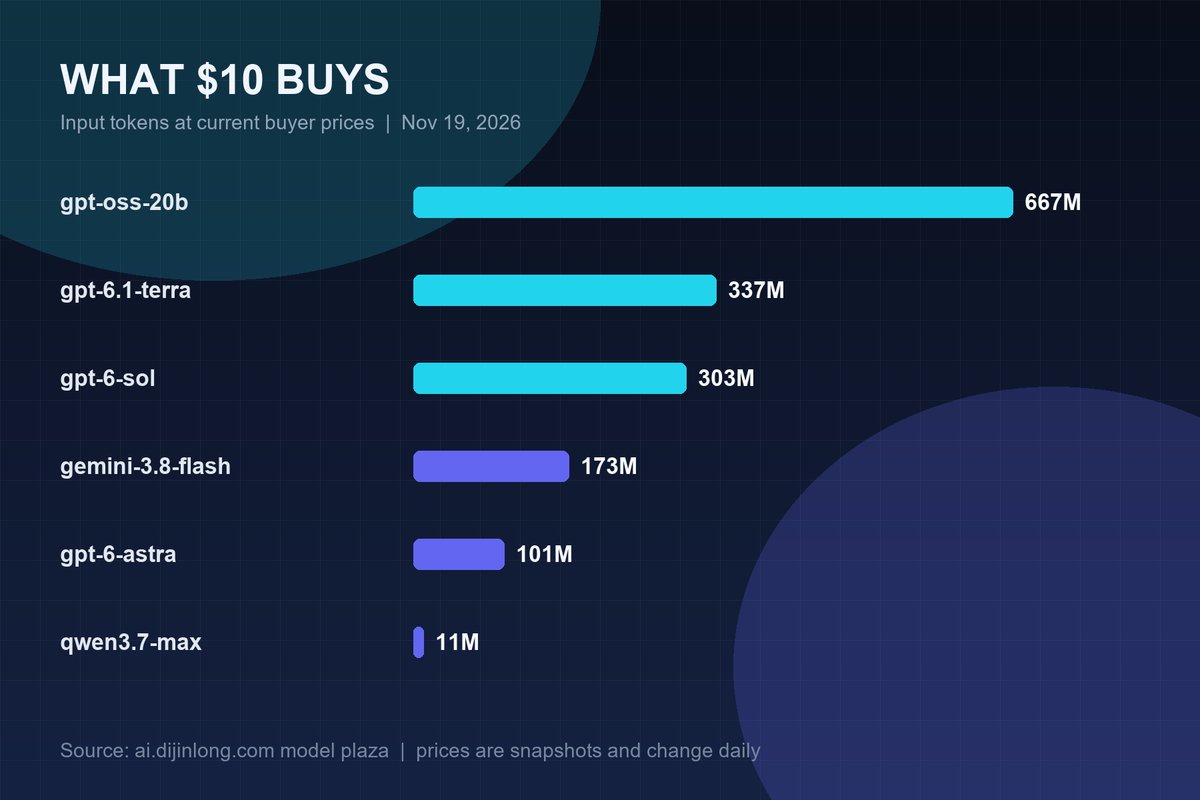
Ten dollars buys anywhere from 4.55 million to 667 million input tokens here, a 147x spread off the same budget. The gap is entirely a selection problem. If you are shopping for cheaper models, do not start by sorting on list price: the runner-up on buyer price, gpt-6.1-terra, carries a sticker 33 times higher than the cheapest listing. What you actually pay is list price multiplied by the seller's discount, and missing either factor skews the math.
Prices below are USD per million tokens. Buyer price equals list price times one minus the discount, as listed on the model plaza today. Figures are current as of November 19.
Start with the cleanest comparison. gpt-oss-20b carries the lowest list price of any text model at $0.03 per million input tokens, but it only trades at 50 percent off, so buyers pay $0.015. gpt-6.1-terra lists at $1, thirty-three times higher, yet runs at 97.03 percent off, which lands it at $0.0297. Double the price, not thirty-three times.
The reverse case matters more. qwen3.7-max lists at a modest $1.79 but sits at 50 percent off, so buyers pay $0.896. gpt-6-astra lists at $10, among the highest stickers on the site, and trades at 99.01 percent off. That works out to $0.099, one ninth of the cheaper-looking model.
One rule covers it: check whether a seller has pushed the price below ten percent of list. A model parked at 50 percent off stays expensive no matter how low its sticker, while a flagship discounted to one percent of list becomes disposable capacity.
| Model | List input | Best discount | Buyer input | $10 buys |
|---|---|---|---|---|
| gpt-oss-20b | $0.03 | 50% off | $0.015 | ~667M tokens |
| gpt-6.1-terra | $1 | 97.03% off | $0.0297 | ~337M tokens |
| deepseek-v4.1-flash | $0.2987 | 89% off | $0.0329 | ~304M tokens |
| gpt-6-sol | $2 | 98.35% off | $0.033 | ~303M tokens |
| gemini-3.8-flash | $0.75 | 92.3% off | $0.0578 | ~173M tokens |
| glm-5.3-flash | $0.1195 | 50% off | $0.0598 | ~167M tokens |
| gpt-6-astra | $10 | 99.01% off | $0.099 | ~101M tokens |
| glm-5 | $0.597 | 50% off | $0.2985 | ~34M tokens |
| qwen3.7-max | $1.79 | 50% off | $0.8958 | ~11M tokens |
| gpt-5.5 | $5 | 56% off | $2.2 | ~4.55M tokens |
The table is ordered by buyer price. Note gpt-5.5 at the bottom: $5 list with only 56 percent off leaves buyers paying $2.20, the steepest of the ten, and $10 stretches to just 4.55 million tokens.
Token counts are abstract, so convert to a request. Take a typical job: 3,000 input tokens, roughly a 2,000-character draft plus a system prompt, and 1,000 output tokens, about 700 characters of answer.
| Model | Cost per request | Requests for $10 | Output to input ratio |
|---|---|---|---|
| gpt-oss-20b | $0.000110 | ~90,909 calls | 4.3x |
| gpt-6.1-terra | $0.000238 | ~42,088 calls | 5.0x |
| deepseek-v4.1-flash | $0.000230 | ~43,474 calls | 4.0x |
| gemini-3.8-flash | $0.000462 | ~21,645 calls | 5.0x |
| gpt-6-astra | $0.000792 | ~12,626 calls | 5.0x |
| glm-5 | $0.002240 | ~4,465 calls | 4.5x |
| qwen3.7-max | $0.005376 | ~1,860 calls | 3.0x |
Two things stand out. Output costs three to five times more than input, so on writing and long-answer workloads the bill is decided by output length. Halving the answer saves more than switching models. Second, the real gap between budget tiers is far smaller than list prices suggest: gpt-oss-20b and gpt-6.1-terra differ 33x on the sticker and only about 2x per request.
Reliability belongs in the same decision. From a single health snapshot: over the past 24 hours gpt-5.6-terra handled about 4,600 calls at 99.76 percent success with a median of roughly 8.6 seconds, while deepseek-v4.1-flash handled about 3,200 calls at 95.19 percent, 8.3 seconds median and 61 tokens per second. These numbers move hourly, so check the live page before committing.
Volume tier (batching, tagging, summaries): gpt-oss-20b paired with glm-5.3-flash. The first costs $0.015 in and $0.065 out; the second $0.0598 and $0.209, with a 1.04 million token window and three sellers, two of them certified. That is about 90,000 and 25,000 short requests respectively.
Balanced tier (customer-facing products): gpt-6.1-terra at $0.0297 in and $0.1485 out, four sellers and one certified, or gpt-6-sol at $0.033 and $0.165 with seven sellers and two certified. That buys roughly 42,000 and 38,000 requests, a clear step up in capability for about 1.5x the price.
Flagship tier (hard reasoning, code review): gpt-6-astra. List is $10 and $50, buyers pay $0.099 and $0.495, and nine sellers list it, the deepest bench on the site. Ten dollars covers about 12,600 short requests or 101 million input tokens.
The split that works: send 80 percent of traffic to the volume tier and 20 percent to the balanced one, reserving the flagship for work that genuinely needs it. Weighted that way, $10 covers about 81,000 short requests, or ten months of internal testing at 8,000 calls a month.
First, judging on input price alone. qwen3.7-max charges $0.896 in and $2.6886 out, making one short request 49 times the cost of gpt-oss-20b. Sorting by input price badly understates that.
Second, ignoring long-context tiers. Past 272,000 input tokens, gpt-6-astra and gpt-5.5 double their input rate, from $10 to $20 and $5 to $10, with output up 50 percent. That halves the purchasing power of your $10 the moment a document gets long; the model card on the model plaza lists the tiers.
Third, thin supply and no track record. gpt-oss-20b has a single seller and no certification, so there is no real call history behind the low quote. gpt-5.5 also has one seller and zero certified, yet sits at the highest buyer price. For production, favor listings with several sellers and certification; the premium buys availability.
Three steps. Filter the plaza by buyer price rather than list price and shortlist three models. Run each against your own prompts about 20 times and watch the usage numbers and output quality. Then split traffic 8 to 2 across two tiers. The full price table is the reference for step one.
One caveat: listings and discounts change daily. Every figure here is a November 19 snapshot, so confirm the live quote before you commit budget.
Past 272K tokens input pricing doubles on most 1M-context models, and qwen3.6-plus jumps 4x at 256K. Real tiers plus four ways around them.
GPT-6.2 cuts list prices 20%, yet platform discounts run deeper: gpt-6-astra trades at under 1% of list. What this week's AI price war means for buyer
Prompt caching stores a repeated prompt prefix and bills cache reads at 5-12% of normal input. Real prices, hit conditions, and how to cut your API bi
Twelve Claude versions are on sale. The newest opus-5-5 costs $8.91 a month; the oldest opus-4-6 costs $49.50. Full table and a pick for each workload
gpt-5.6-terra and deepseek-v4.1-flash win on price and reliability; gemini-3.8-flash is fastest. Effective prices, measured speed, and a three-tier pi
 LONG AI