Zhipu GLM Models: All 11 Versions Priced (2026)
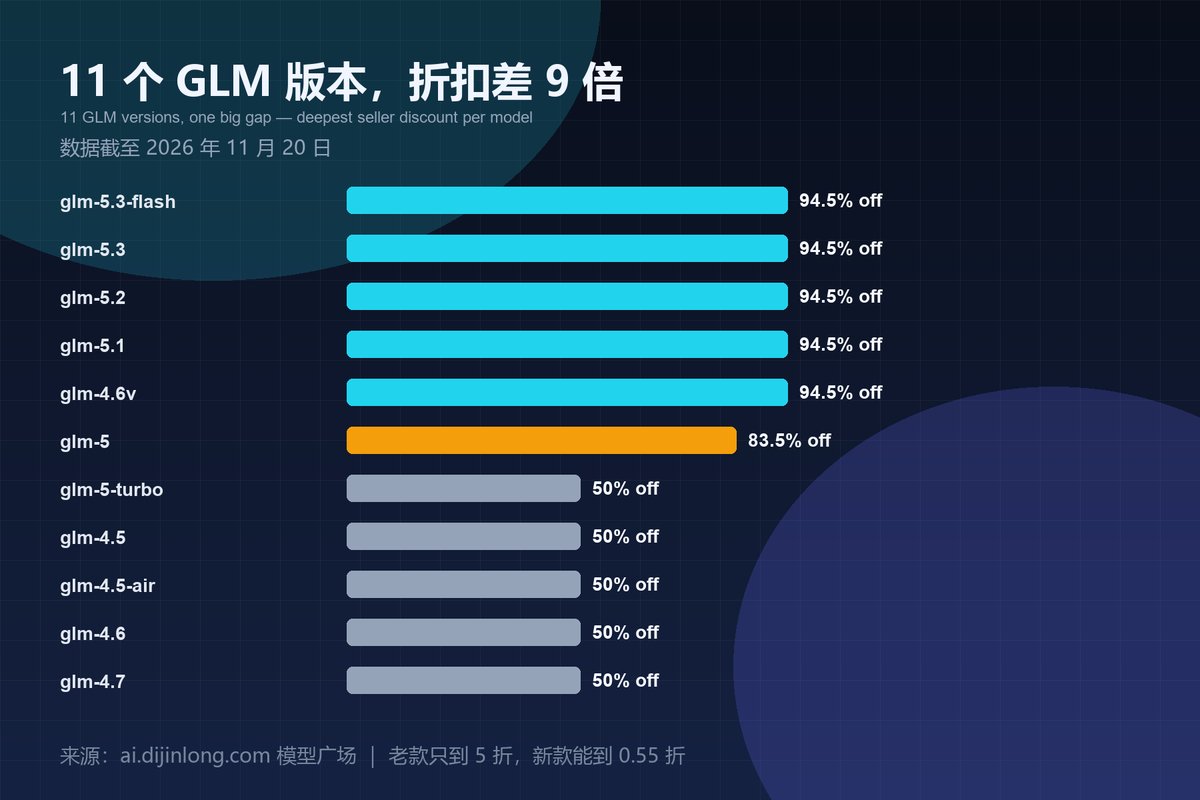
The takeaway: eleven GLM versions, and the newest is often the cheapest
Zhipu currently lists 11 GLM models on the platform, spanning 128K to 1M of context. The counterintuitive part is the pricing: the newest flagship carries the highest list price and the lowest price you actually pay. glm-5.3 lists at $1.195 per million input tokens against $0.2987 for glm-4.7, roughly four times more. After seller discounts, glm-5.3 costs $0.0657 and glm-4.7 costs $0.1494, so the newer model is 56% cheaper. Data as of Nov 20, 2026.
The reason has nothing to do with the models and everything to do with discount tiers. The four older versions sit at a single 50% off tier, while the five newer ones reach 94.5% off. A ninefold gap in discount rewrites the entire price ranking.
The full price table for all 11 versions
Sorted by list price, with the deepest available seller tier applied. Prices are USD per million tokens.
| Model | Context | List (in / out) | Deepest tier | You pay (in / out) | Max output | Sellers |
|---|---|---|---|---|---|---|
| glm-4.5 | 128K | $0.6 / $2.2 | 50% | $0.3 / $1.1 | 96K | 1 |
| glm-4.5-air | 128K | $0.1195 / $0.2987 | 50% | $0.0597 / $0.1494 | 96K | 2 |
| glm-4.6 | 200K | $0.6 / $2.2 | 50% | $0.3 / $1.1 | 128K | 2 |
| glm-4.6v | 128K | $0.149 / $0.448 | 94.5% | $0.0082 / $0.0246 | 32K | 1 |
| glm-4.7 | 200K | $0.2987 / $1.195 | 50% | $0.1494 / $0.5975 | 128K | 2 |
| glm-5 | 200K | $0.597 / $2.688 | 83.5% | $0.0985 / $0.4435 | 128K | 3 |
| glm-5-turbo | 198K | $0.7468 / $3.286 | 50% | $0.3734 / $1.643 | 128K | 2 |
| glm-5.1 | 200K | $0.896 / $3.585 | 94.5% | $0.0493 / $0.1972 | 128K | 3 |
| glm-5.2 | 1M | $1.195 / $4.183 | 94.5% | $0.0657 / $0.2301 | 922K | 4 |
| glm-5.3 | 1M | $1.195 / $4.183 | 94.5% | $0.0657 / $0.2301 | 922K | 6 |
| glm-5.3-flash | 1M | $0.1195 / $0.4182 | 94.5% | $0.0066 / $0.023 | 128K | 7 |
Three price bands emerge. The bottom band is glm-5.3-flash and glm-4.6v, both under one cent per million input tokens. The middle band is glm-5.1, glm-5.2, glm-5.3 and glm-5, between five and ten cents. The top band is glm-4.5, glm-4.6 and glm-5-turbo at 30 to 37 cents, which makes the older generation the most expensive option on the page.
Why the higher list price wins: tiers set the order
Prices here come from sellers, not from the platform. The platform only enforces a band: no listing may exceed 50% of the official price, and the floor is 0.01%. The more sellers a model attracts, the more pressure there is to cut, because cheaper listings win more traffic.
That is exactly where the older versions lose. glm-4.5, glm-4.5-air, glm-4.6 and glm-4.7 each have only a single 50% off tier, with no seller pushing lower. Every version from glm-5.1 onward has at least one tier at 94.5% off. The result: glm-4.5 lists at just $0.6 yet costs $0.30, which is 4.6 times more than glm-5.3 at a $1.195 list price.
Pick by workload: four needs, four answers
Long context on a budget: glm-5.3-flash. One million tokens of context at $0.0066 in and $0.023 out, the fifth cheapest effective input price among all 1M-context models on the platform, backed by 7 sellers and 3 certified ones.
Production coding and long-horizon agents: glm-5.3, or glm-5.2 if you need a second option. Both list at $1.195 and $4.183 with identical discounts, 1M context and 922K max output. glm-5.3 has 6 sellers against 4 for glm-5.2, so it is the safer default.
Images, video and scanned documents: glm-4.6v, one of the few versions here that accepts image and video input. 128K context, $0.0082 in and $0.0246 out. The catch is a single seller, so keep a vision-capable fallback ready.
High-volume text with modest requirements: still glm-5.3-flash. At $0.0066 in and $0.023 out it undercuts glm-4.5-air at $0.0598 and $0.149 by nine and 6.5 times, with eight times the context. The older versions simply have no price edge here.
Two places GLM saves you money
Every GLM version supports caching, with a cache read rate running from $0.0239 on glm-4.5-air to $0.299 on glm-5.3. Cached input is billed at that rate instead of the full input rate. Cache storage is currently free for a limited period, so fixed system prompts and pinned knowledge bases pay off immediately.
The second lever is tiered pricing. glm-5, glm-5.1 and glm-5-turbo all raise rates once input passes 32K. Zhipu quotes these official rates in CNY, unlike the USD figures in the table above: glm-5 moves from 4 to 6 per million input and 18 to 22 output, glm-5.1 from 6 to 8 and 24 to 28, glm-5-turbo from 5 to 7 and 22 to 26. glm-4.7 steps up from 32K and caps context at 200K. glm-5.2 and glm-5.3 use a single flat rate across their 1M window, which makes them easier to budget for long documents.
Three traps worth avoiding
First, glm-5-turbo costs more than glm-5. It lists at $0.7468 and $3.286 against $0.597 and $2.688, and its only tier is 50% off, leaving an effective $0.3734, or 3.8 times glm-5. The turbo label refers to tuning for agent workflows, not to being faster or cheaper.
Second, glm-4.5 and glm-4.6 share a price but not a spec. Both list at $0.6 and $2.2 with the same 50% tier, yet glm-4.6 offers 200K of context instead of 128K and adds structured output. At an identical price there is no reason to pick glm-4.5.
Third, never rank by list price alone. List prices span $0.1195 to $1.195, a tenfold range, while effective prices span $0.0066 to $0.3734, a 56-fold range. The two orderings barely overlap. Sort by the effective price on the Model Plaza and use list price only to judge how expensive a model is in absolute terms.
How to get started
Three steps: shortlist two or three candidates by effective price on the plaza, confirm context and max output on the model docs, then pick a primary and a backup with a preference for models that have three or more sellers. GLM model names carry their version number, and you pass them through exactly as listed, with no need to assemble upstream identifiers yourself.
If you want one line to remember: glm-5.3-flash covers long context at the lowest cost, glm-5.3 covers production coding, glm-4.6v covers vision, and the older versions only make sense when you need their exact compatibility.
Related Articles
Do Failed AI API Calls Cost You Money?
Failed AI API calls are never billed. Errors post a zero-cost row, and 57 of 103 models have backup sellers for automatic retry.
Long-Context Pricing: Why 272K Tokens Cost Double
Past 272K tokens input pricing doubles on most 1M-context models, and qwen3.6-plus jumps 4x at 256K. Real tiers plus four ways around them.
What $10 Actually Buys on an AI API Marketplace
$10 buys 4.55M to 667M input tokens here, a 147x spread. Real discount math, per-request costs, three budget builds, and the traps behind cheap models
GPT-6.2 Cuts Prices 20%: What the AI Price War Means
GPT-6.2 cuts list prices 20%, yet platform discounts run deeper: gpt-6-astra trades at under 1% of list. What this week's AI price war means for buyer
What Is Prompt Caching? How Cache Tokens Cut API Bills
Prompt caching stores a repeated prompt prefix and bills cache reads at 5-12% of normal input. Real prices, hit conditions, and how to cut your API bi