Conclusion first: one key can indeed call every model, but what actually trips people up isn't the key - it's the name. I fired the same key at 4 model names in a row: 3 worked, 1 returned 404. And that 404 name is printed right there in the /v1/models response.
Everything below is measured: commands, bills, raw errors. Even if you don't use our service, the same method applies to any API relay.
Pull the model list with one key and you get 805 IDs (measured 2026-11-03). The model plaza homepage says "190 models, 935 listings, one key."
The two numbers are 600 apart, for two reasons: one model hosted on different upstreams takes up one name each (evidence in section 2 below); and the list also contains image and audio models that aren't in the plaza's text area.
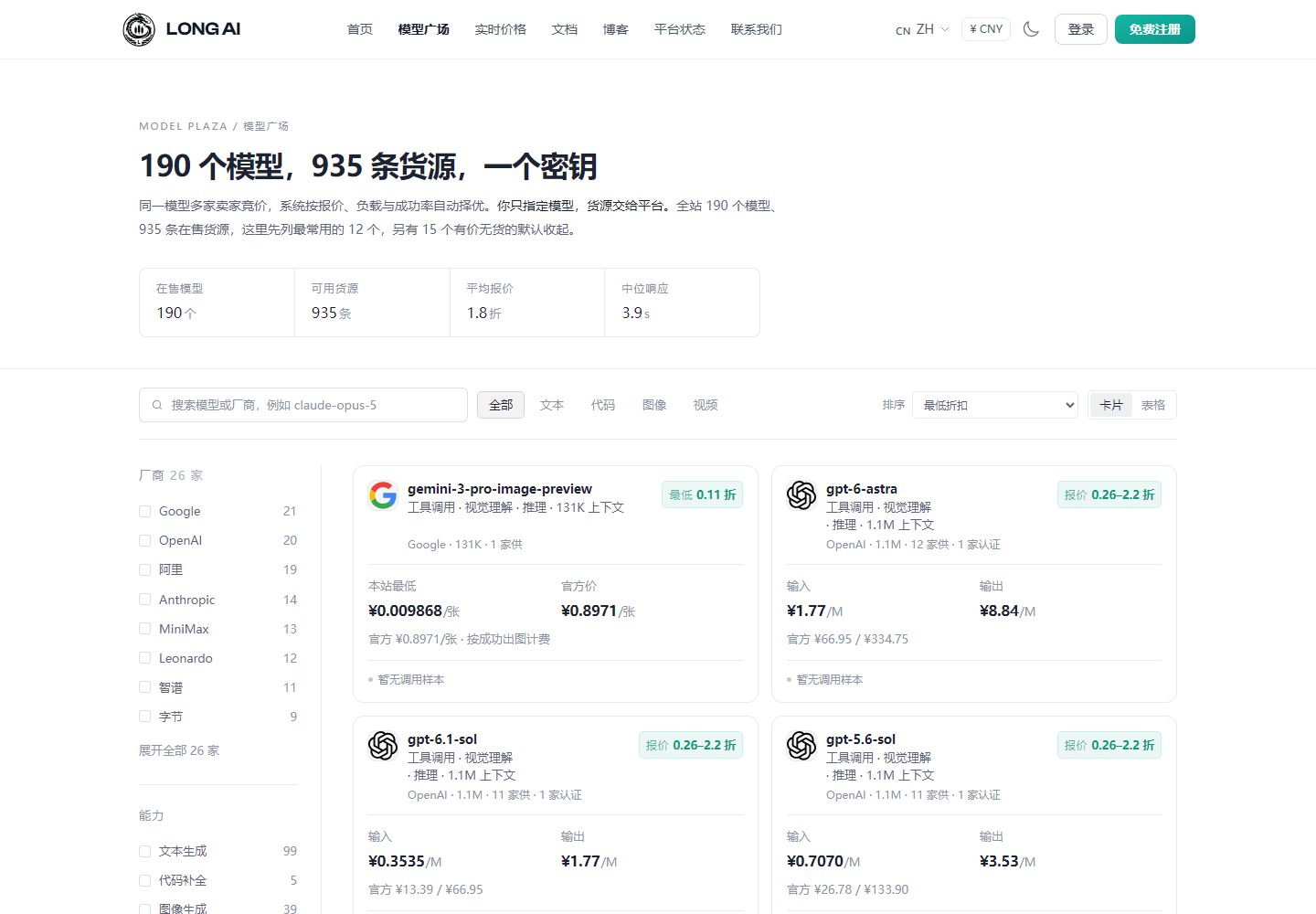
So get one thing straight: /v1/models is a list of names, while the plaza is the list of what's actually buyable. They are not the same thing.
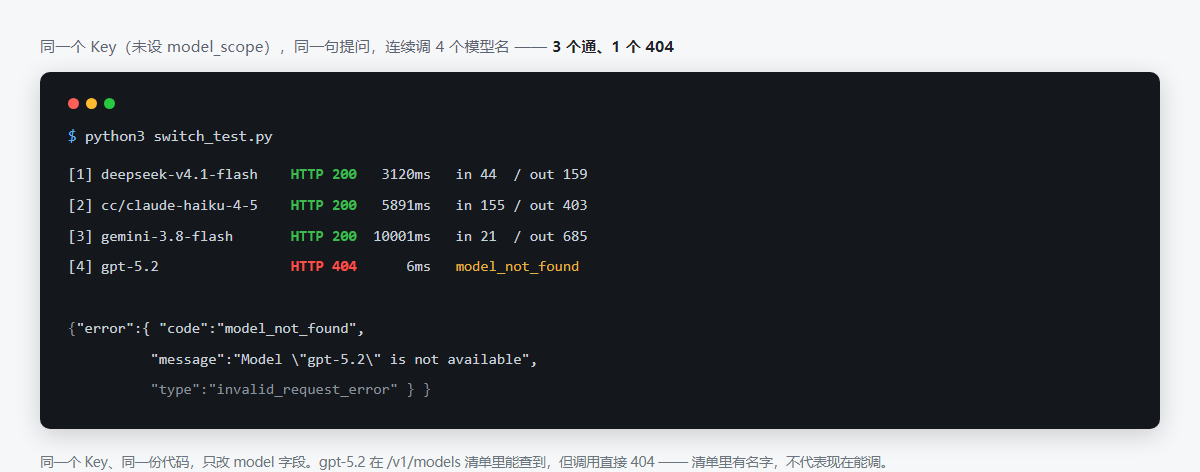
Measured proof: gpt-5.2 shows up in /v1/models but can't be found on the plaza. Calling it directly:
HTTP/1.1 404 Not Found

{"error": {"code": "model_not_found",
           "message": "Model "gpt-5.2" is not available",
           "type": "invalid_request_error"}}
So the "query the list, run if present" pattern in scripts is unreliable. What's callable is whatever the plaza search finds.
Scrolling the list, DeepSeek's one model shows up in several spellings. I picked 5 and called each once, all 200:
deepseek-v4.1-flash - 35 input tokensali/deepseek-v4.1-flash - 44 input tokenscb/deepseek-v4.1-flash - 35 input tokensalicn/deepseek-v4.1-flash - 44 input tokensDeepSeek-V4.1-Flash (uppercase + hyphens) - 51 input tokensThe same sentence produced 35 to 51 input tokens, a 46% spread. It's not the model changing; it's the upstream behind it being different: prefixed spellings lock onto a specific seller, the bare name is routed by the system, and the uppercase one is a separate entry with a different tokenizer.
Practical takeaway for ordinary users: don't pick prefixed names from the list yourself. Prefixes exist for scenarios that need a specific seller; day to day, just write the canonical name shown on the plaza and let the platform handle routing, price comparison, and failover.
Same key, same sentence - "explain in one sentence what HTTP 404 means, under 30 Chinese characters" - fired at three vendors in turn:
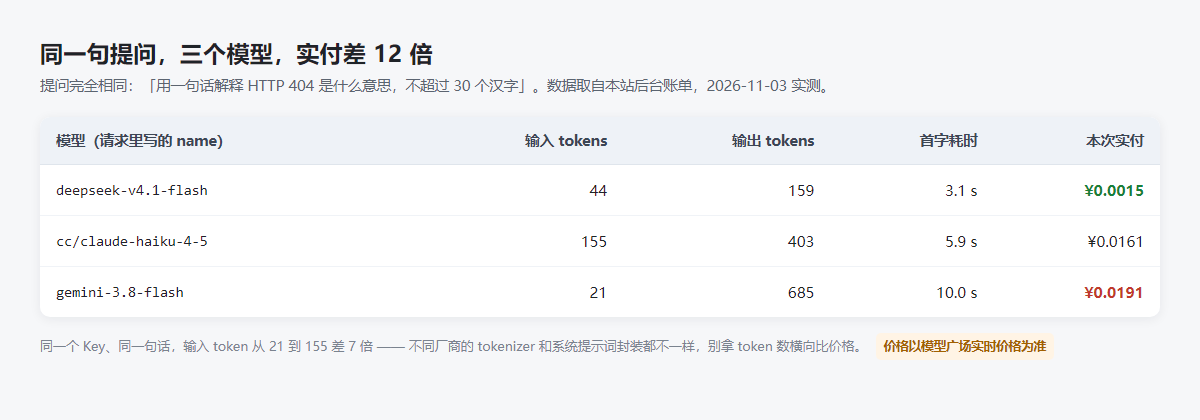
Three counter-intuitive points:
The conclusion is blunt: within one key, price differences between models run to double-digit multiples - check the plaza quote before switching, don't go by memory. For vendor official prices vs. our actual prices, see our four-vendor price comparison; specific unit prices follow the model plaza in real time.
The API is OpenAI-compatible, so switching models needs no SDK swap and no new key, just the model field:
import requests

KEY = "sk-your-key"
URL = "https://ai.dijinlong.com/v1/chat/completions"

def ask(model, question):
    r = requests.post(URL, timeout=120,
        headers={"Authorization": f"Bearer {KEY}"},
        json={"model": model,
              "messages": [{"role": "user", "content": question}],
              "max_tokens": 800})
    r.raise_for_status()
    d = r.json()
    return d["choices"][0]["message"]["content"], d["usage"]

for m in ["deepseek-v4.1-flash",
          "claude-haiku-4-5",
          "gemini-3.8-flash"]:
    text, usage = ask(m, "explain HTTP 404 in one sentence")
    print(m, usage["prompt_tokens"],
          usage["completion_tokens"])
Three rules:
timeout to every call. The three vendors took 3 to 10 seconds for the first token; a slow model without a timeout hangs your program.usage. The same sentence differed 7x in input tokens across three vendors; without logging you'll never know what you're paying for. Multi-turn history bills repeatedly - see this token-billing test for the turn-by-turn breakdown.model_scope); anything outside it is reported as "doesn't exist." I used an OpenAI-only key to call DeepSeek and got the exact same 404 line as above.gpt-5.4 returned 503 three times in a row, while gpt-6-sol returned 200 in the same window.max_tokens is too small and the budget got eaten by reasoning.max_tokens to 800+; leave headroom for these models.To start, register and create one key to cover every model - no separate signup per vendor.
GPT-6.2 cuts list prices 20%, yet platform discounts run deeper: gpt-6-astra trades at under 1% of list. What this week's AI price war means for buyer
Prompt caching stores a repeated prompt prefix and bills cache reads at 5-12% of normal input. Real prices, hit conditions, and how to cut your API bi
Twelve Claude versions are on sale. The newest opus-5-5 costs $8.91 a month; the oldest opus-4-6 costs $49.50. Full table and a pick for each workload
gpt-5.6-terra and deepseek-v4.1-flash win on price and reliability; gemini-3.8-flash is fastest. Effective prices, measured speed, and a three-tier pi
Point your base URL at the platform and one key covers all 138 on-sale models across 51 vendors, in both OpenAI and Anthropic request formats. Copy-pa
 LONG AI