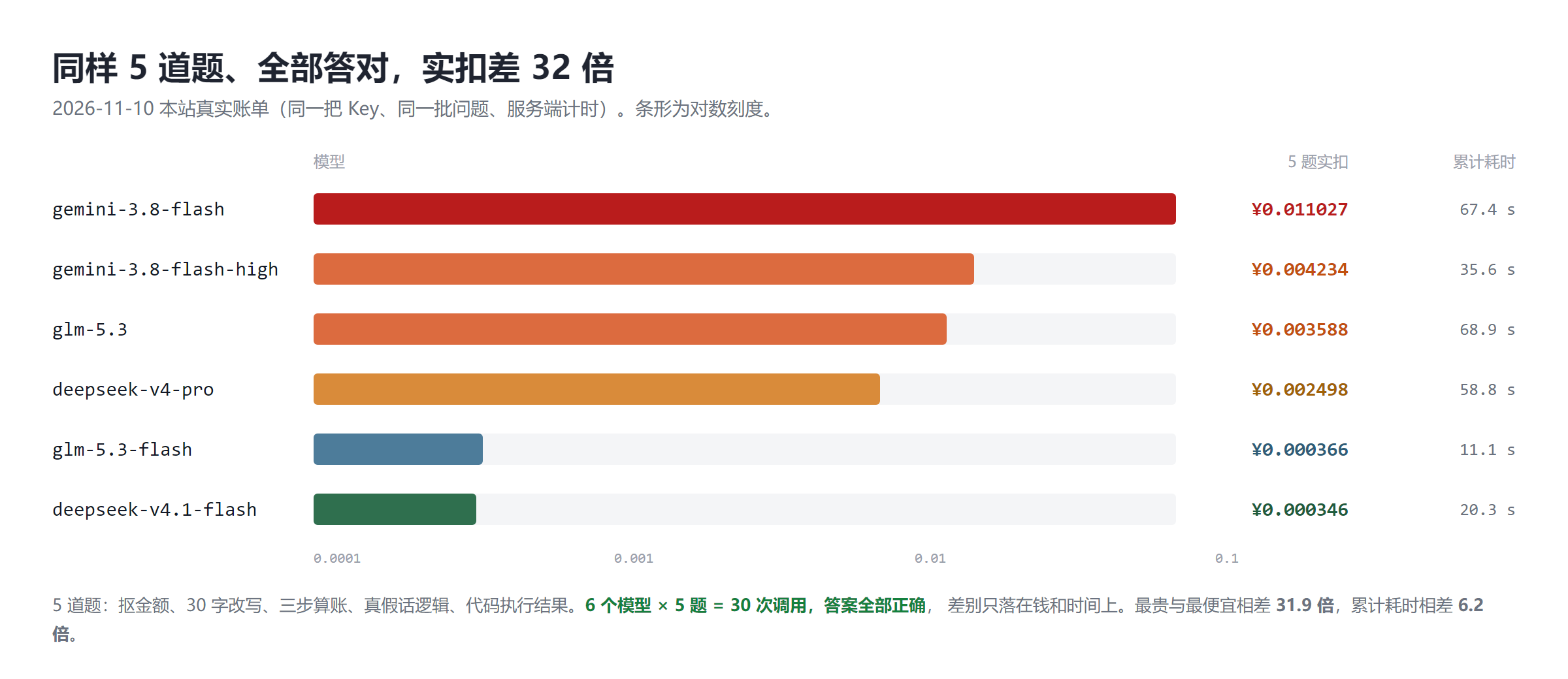
Conclusion first: six models ran the same batch of 5 everyday questions - 30 calls, all correct - with the priciest charging ¥0.011027 and the cheapest ¥0.000346, a 31.9x spread. I added 3 questions that "look like they need thought" (make 24, the 12-coin balance puzzle, a 9-step chain) - still all correct. Across the questions I tested, the extra money bought more invisible thinking tokens and longer waits, not more accurate answers.
Method: same key, same prompts, no temperature set; timing from our server logs, amounts from actual charges in usage records, not estimated from unit prices. Every model name is searchable on the model plaza; prices follow the plaza in real time.
| Model | 5-question charge (¥) | Total time | Correct |
|---|---|---|---|
| gemini-3.8-flash | 0.011027 | 67.4 s | 5 / 5 |
| gemini-3.8-flash-high | 0.004234 | 35.6 s | 5 / 5 |
| glm-5.3 | 0.003588 | 68.9 s | 5 / 5 |
| deepseek-v4-pro | 0.002498 | 58.8 s | 5 / 5 |
| glm-5.3-flash | 0.000366 | 11.1 s | 5 / 5 |
| deepseek-v4.1-flash | 0.000346 | 20.3 s | 5 / 5 |
The questions: extract a payable amount, rewrite in 30 words, a three-step calculation, a truth-lie logic puzzle, and reading code output.
The widest gap was the rewrite:
Both answers are usable. The money differed 55.7x and the time 8.8x, and all you got was a difference in wording - the classic shape of a misused model isn't worse results, it's pure spending with zero return.
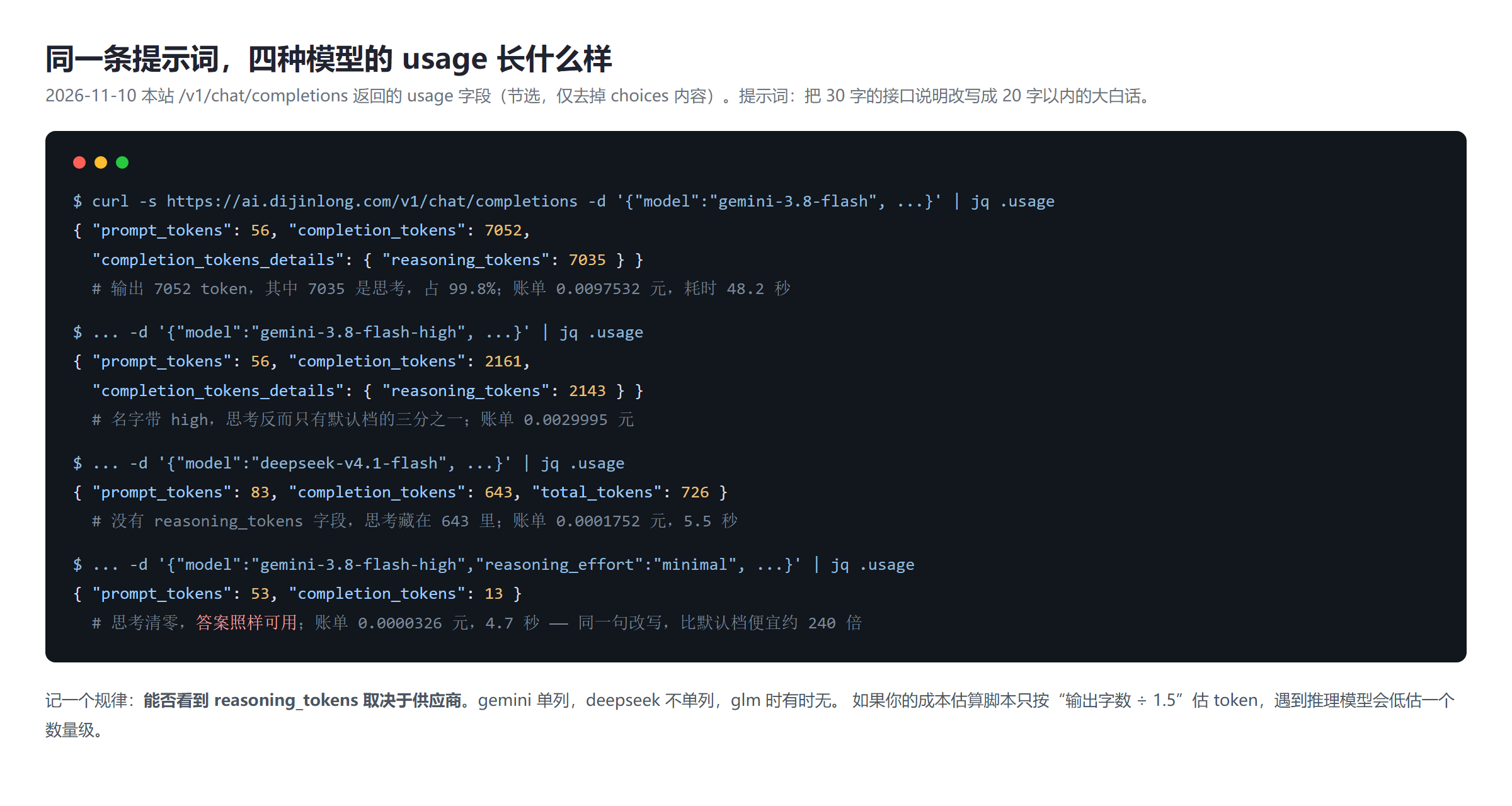
The same question output 7,052 tokens, of which 7,035 were reasoning_tokens - the actual answer was a dozen or so words. Thinking is billed at the output rate, and output is usually 5x the input price.
And a more hidden leak: the input side. The same 88-character question logged 7,437 input tokens on glm-5.3-flash, while glm-5.3 on the same question took only 76. A model's built-in system prompt and tool definitions all bill at the input rate - that question cost ¥0.000336 on glm-5.3-flash vs ¥0.000167 on glm-5.3. Ten times cheaper per token, and the bill came out higher.
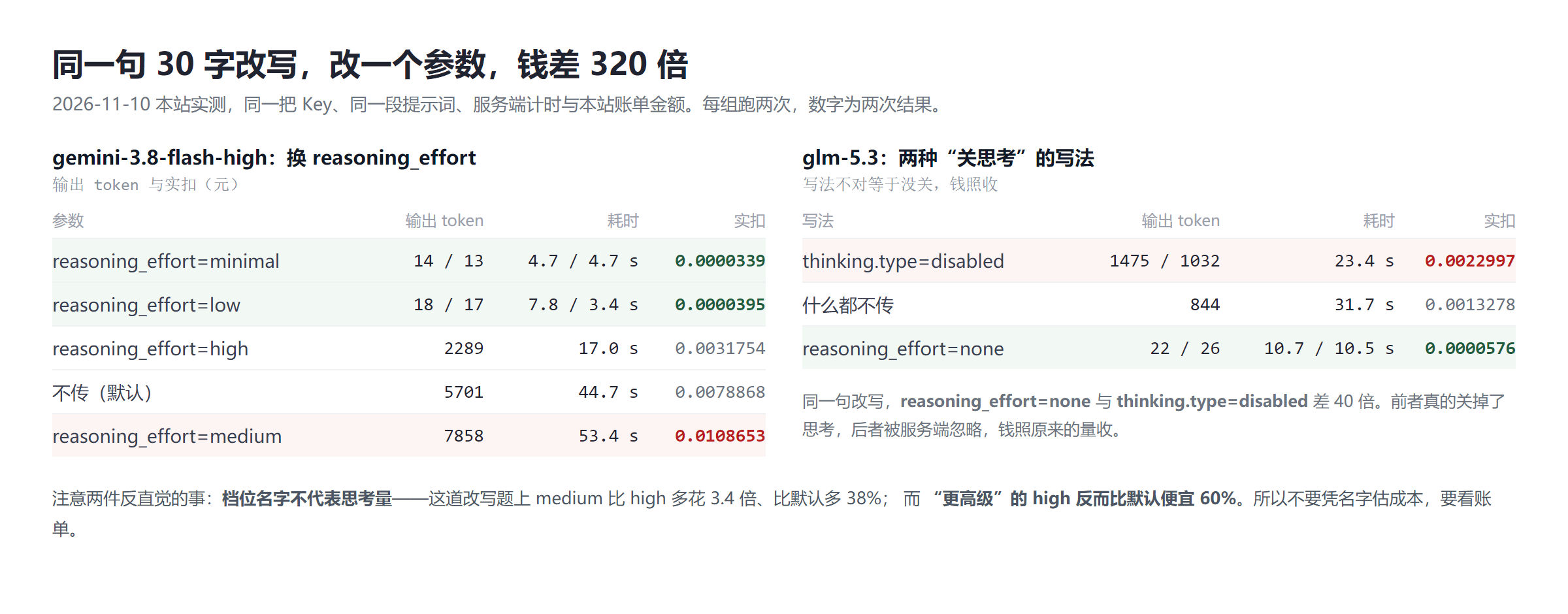
Every reasoning model exposes a thinking-budget knob - the catch is the parameter name differs per vendor, and a wrong name doesn't error, it's silently ignored while you keep paying. The same rewrite, run twice per setting, numbers reproduced stably:
| gemini-3.8-flash-high parameter | Output tokens | Time | Charge (¥) |
|---|---|---|---|
| reasoning_effort = minimal | 13 ~ 14 | 4.7 s | 0.0000326 ~ 0.0000339 |
| reasoning_effort = low | 17 ~ 18 | 3.4 ~ 7.8 s | 0.0000381 ~ 0.0000395 |
| reasoning_effort = high | 2289 | 17.0 s | 0.0031754 |
| no parameter (default) | 5701 | 44.7 s | 0.0078868 |
| reasoning_effort = medium | 7858 | 53.4 s | 0.0108653 |
Two counter-intuitive points:
thinking: {"type":"disabled"} does nothing - output 1,475 tokens, charged ¥0.0022997; switching to reasoning_effort: "none" actually turned it off - 22 tokens, ¥0.0000576, a 40x difference. gemini understands minimal / low.So don't trust the docs - send it and check the returned usage: output tokens dropping to single digits is the only proof it's really off.
Three questions: make 24 from 3, 3, 8, 8 (answer 8/(3-8/3)); the 12-coin balance puzzle with unknown heavy/light (minimum 3 weighings); a 9-step chain (237). Not one fumbled. deepseek-v4.1-flash solved the chain in 81 tokens and 2.4s, and the make-24 in 111 tokens and 5.5s.
It was deepseek-v4-pro that spent 503 tokens and 10.7s on the same make-24, charging 14x for the identical answer. So "looks hard" is not a reason to turn on reasoning; what actually separates models is long chains, multiple constraints, and tasks that need repeated self-checking - and you can only find that by testing with your own questions.
Why 10: a single question can be luck; you need three repeats to check stability. Prices follow the model plaza in real time; the same model has different discounts per seller.
1) Why is completion_tokens dozens of times the answer length?
Thinking tokens bill as output, but most providers don't put the thinking into the answer text. gemini lists reasoning_tokens separately; deepseek only has reasoning_content with the tokens merged into completion; glm is inconsistent. Seeing 7,052 with a 20-word answer is normal.
2) I set max_tokens, why is it still slow or the answer truncated?
Thinking counts against the max_tokens budget. Give it too small a budget and the model runs out mid-thought and can't produce the answer. Leave 3-5x headroom over your expected answer length.
3) I passed the "turn off thinking" parameter, why didn't the bill drop?
A wrong parameter name gets ignored. There's only one way to tell: check whether the returned usage's output tokens dropped. glm-5.3 accepts reasoning_effort=none but not thinking.type=disabled - measured on Nov 10.
4) Why is my input tokens so much longer than my prompt?
The model's built-in system prompt, tool definitions, and format constraints all count as input. This batch saw the same sentence at 76 and 7,437 input tokens - scripts estimating cost by word count must calibrate against the bill.
5) How to fall back when a cheap model occasionally gets it wrong?
Run the cheap tier first; on an obvious failure signal (empty output, JSON parse failure, "cannot determine") escalate to a reasoning tier and rerun once. 95% of requests take the cheap path, only 5% pay the expensive rate. How to switch models under one key - see the site docs.
All amounts here are real charges from 2026-11-10. Prices move with sellers and promotions - check the plaza before ordering; a model's default thinking behavior may also change after updates, so rerun the self-test quarterly.
GPT-6.2 cuts list prices 20%, yet platform discounts run deeper: gpt-6-astra trades at under 1% of list. What this week's AI price war means for buyer
Prompt caching stores a repeated prompt prefix and bills cache reads at 5-12% of normal input. Real prices, hit conditions, and how to cut your API bi
Twelve Claude versions are on sale. The newest opus-5-5 costs $8.91 a month; the oldest opus-4-6 costs $49.50. Full table and a pick for each workload
gpt-5.6-terra and deepseek-v4.1-flash win on price and reliability; gemini-3.8-flash is fastest. Effective prices, measured speed, and a three-tier pi
Point your base URL at the platform and one key covers all 138 on-sale models across 51 vendors, in both OpenAI and Anthropic request formats. Copy-pa
 LONG AI