On Oct 19, MiniMax's official blog published "MiniMax M3.1 Flash: Redefining Agent Performance and Cost," and the same day the open platform's model-release page listed the new model. (Source: MiniMax official blog 2026-10-19, minimax.cn/blog/minimax-m31f; open platform release notes 2026-10-19, platform.minimax.cn/docs/release-notes/models; official pricing platform.minimax.cn/docs/pricing/overview)
In one sentence: a new model shipped, official price cut in half, yet it's still 5x pricier than the M3 we sell on the plaza. Let's break it down.
1. Price halved. The official pricing page is clear: M3.1 Flash is ¥1 per million input tokens, ¥4 output, ¥0.1 cached read. The previous M3 (input within 512K) was ¥2.10 in / ¥8.40 out. Do the math: 1 − 1.00 ÷ 2.10 = 52.4% cheaper, and output the same 52.4%. Above 512K, M3 cost 4.20 / 16.80, an even bigger gap.
2. Faster. The official claim is 200+ TPS for everyday output, median (P50) stable at 170+ TPS, roughly 3x the previous generation in online inference.
3. More capable. Native multimodal, 1M context, adjustable thinking depth. Official numbers: DeepSWE v1.1 coding 73.7%, OSWorld V2 computer-use 61.7, ALE 29.6, CyberGym security 82%, BankerToolBench 76.2. MiniMax also says the earlier anonymous "Space Bunny" was an early build of this model, handling over 200T tokens. The two computer-use scores (OSWorld V2, ALE) they claim lead domestic models.
4. The "70% lower total cost" claim needs unpacking. That's a task-level figure - it stacks the halved unit price, shorter output, and cheaper cache. It is not a 70% unit-price cut (the unit price dropped 52%). Budget on the unit price, not on 70%.
Can you use it officially: yes. Model name MiniMax-M3.1-Flash; already live on MiniMax API, MPlan subscription, and MiniMax Code. Weights, officially "coming later."
Will the old model stop: no. The announcement doesn't mention retiring M3; M3 keeps working at its unchanged official price.
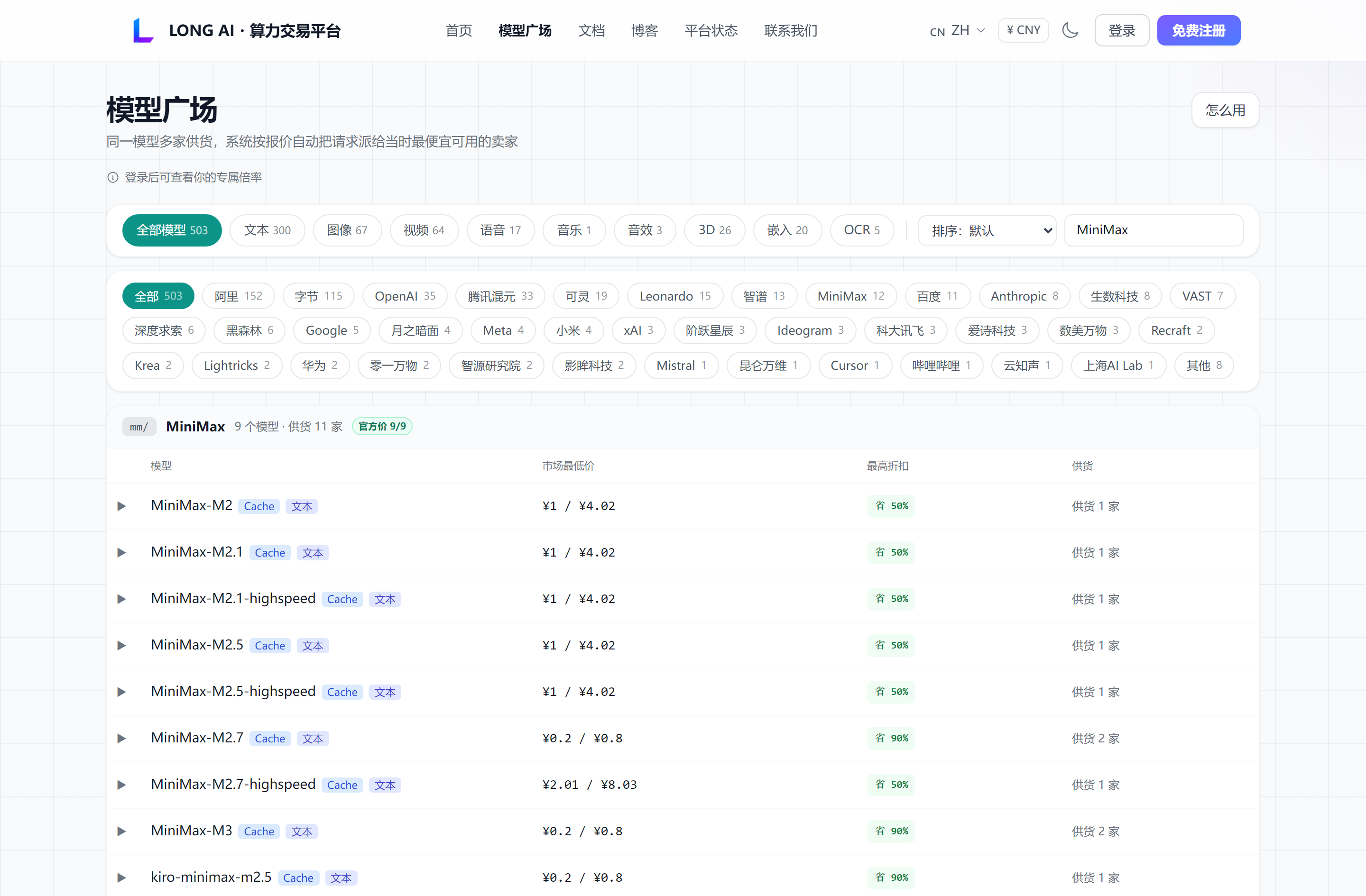
Can you use it here: not yet. Searching MiniMax on our plaza on the morning of Oct 20 returns 9 models (M2, M2.1, M2.5, M2.7, M3 and their highspeed variants), no M3.1.
What's genuinely new: the "adjustable thinking depth." For simple jobs like classification or extraction you can dial thinking down, and crank it up for complex agents - that saving space is bigger than the unit-price cut itself.
Who's cheaper (the most counter-intuitive bit): the new model's official price is 47.6% of the old one, but it's a full 5x pricier than our plaza's M3 - the plaza's M3 currently lists at ¥0.20 in / ¥0.80 out (labeled "90% off," 2 sellers).
Take a typical task: 1M input + 200K output. Cost = 1 × input price + 0.2 × output price.
Same job: the new model's official price is ¥1.80, half of the old official ¥3.78; but against our plaza's ¥0.36 it's still 5x more (1.80 ÷ 0.36 = 5).
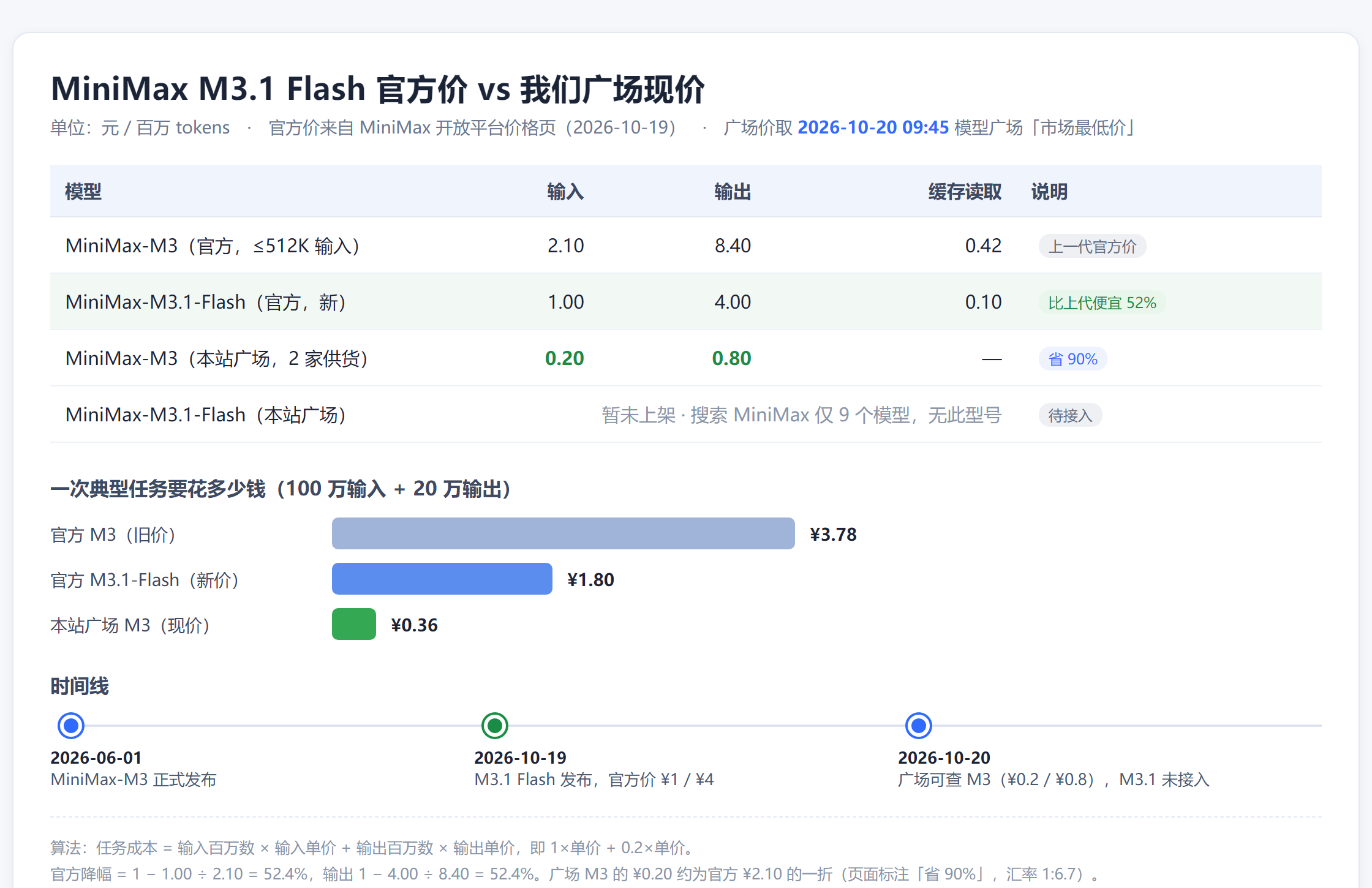
(Data from the official announcement and our own testing, 2026-10-20; prices follow the actual order page.)
GPT-6.2 cuts list prices 20%, yet platform discounts run deeper: gpt-6-astra trades at under 1% of list. What this week's AI price war means for buyer
Prompt caching stores a repeated prompt prefix and bills cache reads at 5-12% of normal input. Real prices, hit conditions, and how to cut your API bi
Twelve Claude versions are on sale. The newest opus-5-5 costs $8.91 a month; the oldest opus-4-6 costs $49.50. Full table and a pick for each workload
gpt-5.6-terra and deepseek-v4.1-flash win on price and reliability; gemini-3.8-flash is fastest. Effective prices, measured speed, and a three-tier pi
Point your base URL at the platform and one key covers all 138 on-sale models across 51 vendors, in both OpenAI and Anthropic request formats. Copy-pa
 LONG AI